Wednesday, February 4, 2009

Engine Proper

[1] Cylinder, Cylinder Block
  A combustion chamber is made up of a cylinder, a cylinder head and a piston.    A cylinder has a cylindrical shape and its inner surface is perfectly finished.
  The piston slides up and down between top dead center and bottom dead center within the cylinder. The cylinder receives the most  complicated forces in the entire engine because of the influence of the pressure and heat generated by the burnt gas.

(1) Cylinder classification
Cylinders can be structurally classified into the following types: 
         cyl.classification   
1) In-block cylinder  
    The cylinder and the cylinder block are manufactured as a solid unit.    Since no cylinder liner is used with an in-block cylinder, it has fewer parts than a liner type cylinder.  For this reason, this type is suitable for  mass production.  Currently, in-block cylinders are used most widely for gasoline engines with cast iron cylinder blocks.
2) Dry liner type
    The cylinder liner housing  of the cylinder block is finished into a cylindrical diameter with a fitting tolerance from the finished imensions of the cylinder.    A separately manufactured cylinder liner is inserted into this.  The cylinder liner is surrounded by the walls of the cylinder block, so it never comes into direct contact with the engine cooling water.

           dry liner    
3) Wet liner type 
     The cylindrical part of the cylinder is made up entirely of the cylinder liner.    The outer surface of the wet liner comes directly in contact with the cooling water.
    For this reason, this type of cylinder liner can be cooled efficiently.   Wet liners are easier to manufacture and assemble than dry liners.     
     The upper part of the cylinder liner has a flange which is used for positioning during assembly and which prevents water from leaking from the top.    The lower part of the cylinder liner has a "rubber ring" to prevent water leakage.  Ordinarily, the liner thickness is 6 – 8% of the inner diameter of the liner.

          wet liner

Tuesday, February 3, 2009

Komatsu 960E-1 Mining Truck

960E-1 Provides High Reliability and the Right Match for Mining

Rolling Meadows, IL, May 27, 2008 - Komatsu America Corp. is pleased to announce the introduction of the 960E-1 (960E) AC electric drive haul truck. The largest of Komatsu’s full line of mining trucks, the new model carries a 360 ton (327 tonnes) payload and weighs 1,270,000 lbs when fully loaded. The 960E balances payload, productivity and power, and is designed to be the right match for today’s mining needs. Just over 24’ tall,the 960E uses modern frame design and manufacturing technology to ensure the quality of this new truck. With over 3 years of experience from coal fields to deep-pit copper mining, Komatsu has tested and proven the 960E to be ready for today’s mining needs.

             image

Komatsu America Corp. is a world leader in electric drive mining trucks and was the first to introduce AC drive systems for ultra-class mining trucks in 1996 with the commercial production of the 930E. Today, the 930E is the best selling ‘ultra-class’ truck with over 650 units operating in the field. The 960E builds on this success and offers customers the right match of production capacity, speed and operating cost for their expansion and fleet replacement needs. From the durable body down to its standard size 56/80R63 tires, the 960E is designed to be the low cost-per-ton leader.

The 960E was created with proven Komatsu heritage in electrical, hydraulic and service systems from the 930E. The 960E is powered by the Komatsu SSDA18V170 which uses a unique dual-stage turbo air handling system to deliver 3,500 horsepower with the lowest brake specific fuel consumption (BSFC) at rated horsepower for this truck class. This engine is matched to the power alternator and is also used on the 930E-SE, a high-power version of the 930E operating in North America, Chile and Australia with over 250,000 hours of operation.

      image

As a key part of any complete service and support program for its mining trucks, Komatsu installs the Vehicle Health Monitoring System (VHMS) on every truck as standard equipment to allow easy access to summary performance data. Using a satellite communications system and optional wireless download, the Komatsu VHMS allows technicians to use a simple Internet web interface to easily check the pressures and trends, summarize yesterday’s payload, and be instantly alerted of critical faults.

Today’s operators require a world-class cab and the 960E delivers, with added sound attenuation, dual air-suspension seats, and room for the operator’s coat and lunch. The updated dashboard includes simplified gauges and a unique display that combines payload and speed, conveniently providing the operator the information needed to operate the truck. The ergonomic layout and comfortable controls enable the operator to focus on productivity.

Komatsu America Corp. is a U.S. subsidiary of Komatsu Ltd. which is the world’s second largest manufacturer and supplier of construction, mining and compact construction equipment. Through its distributor network, Komatsu offers a state-of-the-art parts and service program to support the equipment. Komatsu has proudly been providing high-quality reliable products for nearly a century. Visit the website at www.komatsuamerica.com for more information.

Komatsu’s Tier 3 Engine Technology

Innovative Engine Technologies for Construction & Mining Equipment

Tier III / EU stage IIIA regulations aim to slash NOx emissions in a big way. But if you lower combustion temperatures to try to do that, you also raise emissions of particulate matter and jack up fuel consumption.

KOMATSU’s innovations have reduced NOx and soot – while boosting fuel economy at the same time! We are using “total vehicle control” to improve performance using the best combination of our advanced technologies.

Key Technology-1

Electronic Control System

image

Komatsu's electronic control system uses a comprehensive set of sensors to optimize vehicle performance to meet the varying needs of operation. This system reduces environmental impact: cutting emissions of particulate matter and NOx, enhancing fuel economy and reducing noise. It also offers better performance in severe environmental conditions, including high altitudes, and extremely high and low temperatures.

Key Technology-2

Heavy Duty HPCR System

image

In this system, a high-pressure pump is used to pump fuel into an accumulator chamber – the so-called "common rail" in the common rail system. From there, the fuel is injected in the engine cylinders with injection optimized by an ECU (electronic control unit). In order to achieve both reduced emissions and high performance, the Heavy Duty HPCR optimizes control of multiple injection volumes ensuring maximum high-pressure performance. It also maximizes combustionÑwhich in turn reduces the production of PM. So, engine power is up; noise is down.

Key Technology-3

Heavy Duty Cooled EGR System

image

This system returns some of the low-oxygen exhaust gas to the cylinders, which helps prevent nitrogen and oxygen from bonding during combustion and has the effect of reducing the production of NOx. The Komatsu Heavy Duty Cooled EGR system has been especially designed for high performance under the most demanding conditions.The twin valves use Komatsu's own highly durable hydraulic drives.
By using "EGR gas" more effectively to meet the high-pressure requirements of construction & mining equipment, this system reduces NOx emissions and improves fuel efficiency at the same time. And the structure of the cooling unit of this system has been designed to enhance the efficiency of cooling by lowering thermal stress. In addition, the EGR cooler is made from special materials for better corrosion-resistance. These features make the system more reliable and durable, so as to meet the needs under the harshest conditions.

Key Technology-4

New Combustion System

image

The shape of the combustion chamber has been specially configured on the basis of computer simulations and analyses. Our New Combustion System optimizes combustion timing and ignition – reducing NOx and PM, improving fuel consumption, and cutting noise – all at the same time.

Key Technology-5

Air to Air Charge Air Cooling System

image

Komatsu uses a turbocharger to feed the engine cylinders with the larger volumes of air necessary to improve combustion efficiency, lower emissions, and enable higher engine power. However, compression generates heat, so we also use a high performance hydraulic cooling fan to cool the air to an optimum temperature and optimize air supply. This contributes to reducing NOx and fuel consumption.

Selengkapnya di : http://www.komatsuamerica.com/Tier3.html

Motor Diesel

A. PRINSIP MOTOR DIESEL DAN BENSIN.

1. Motor Diesel.

Udara yang terhisap ke dalam ruang bakar dikompresi sehingga mencapai tekanan dan temperatur yang tinggi. Bahan bakar ( fuel ) diinjeksikan dan dikabutkan ke dalam ruang bakar. Sehingga terjadi pembakaran sesaat setelah terjadi pencampuran dengan udara.

Prinsip Motor Diesel

2. Motor Bensin.

Udara dan bahan bakar yang tercampur didalam carburator, terhisap ke dalam ruang bakar dan dikompresikan hingga mencapai tekanan dan temperatur tertentu. Pada akhir langkah kompresi, busi memercikan api sehingga terjadi pembakaran.

Prinsip kerja motor bensin

Perbedaan Diesel engine & Gasoline Engine

Perbedaan diesel dan bensin

B. MOTOR 4 LANGKAH DAN 2 LANGKAH.

1. Prinsip Kerja Motor Diesel 4 Langkah.

diesel_principle

Gbr. I - 3.Prinsip kerja motor diesel 4 langkah.

a. Langkah hisap ( intake stroke ).

Piston bergerak dari Titik Mati Atas ( TMA ) ke Titik Mati Bawah ( TMB ). Intake valve terbuka dan exhaust valve tertutup, udara murni masuk ke dalam silinder melalui intake valve.

b. Langkah kompresi ( Compression stroke ).

Udara yang berada di dalam silinder dimampatkan oleh piston yang bergerak dari Titik Mati Bawah ( TMB ) ke Titik Mati Atas ( TMA ), dimana kedua valve intake dan exhaust tertutup. Selama langkah ini tekanan naik 30 - 40 kg/cm2 dan temperatur udara naik 400 - 500 derajat celcius.

c. Langkah Kerja ( power stroke ).

Pada langkah ini, intake valve dan exhaust valve masih dalam keadaan tertutup, partikel - partikel bahan bakar yang disemprotkan oleh nozzle akan bercampur dengan udara yang mempunyai tekaan dan suhu tinggi, sehingga terjadilah pembakaran yang menghasilkan tekanan dan suhu tinggi. Akibat dari pembakaran tersebut, tekanan nak 80 ~ 110 kg/cm2 dan temperatur menjadi 600 ~ 900 derajat celcius.

d. Langkah buang ( exhaust stroke ).

Exhaust valve terbuka sesaat sebelum piston mencapai titik mati bawah sehingga gas pembakaran mulai keluar. Piston bergerak dari TMB --- > TMA mendorong gas buang keluar seluruhnya.

Kesimpulan : Empat kali langkah piston atau dua kali putaran crank shaft, menghasilkan satu kali pembakaran.

2. Prinsip Kerja Motor Bensin 4 Langkah.
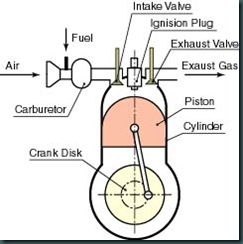
gasoline_e1

Gambar 1.4 Prinsip kerja motor bensin 4 langkah.

a. Langkah hisap ( intake stroke ).

Piston bergerak dari Titik Mati Atas ( TMA ) ke Titik Mati Bawah ( TMB ). Intake valve terbuka dan exhaust valve tertutup, udara bersih yang tercampur di karburator, terhisap masuk ke dalam ruang silinder.

b. Langkah kompresi ( Compression stroke ).

Campuran udaradan bahan bakar dimampatkan oleh piston yang bergerak dari titik mati bawah ke titik mati atas sehingga tekanan dan temperatur campuran tersebut naik.

c. Langkah Kerja ( power stroke ).

Beberapa derajat sebelum mencapai titik mati atas, campuran udara dan bahan bakar tersebut diberi percikan api oleh busi, sehingga terjadi pembakaran.

Akibatnya, tekanan naik menjadi 30 - 40 kg/cm2 dan temperatur pembakaran menjadi 1500 derajat celcius. Tekanan tersebut bekerja pada luasan piston dan menekan piston menuju ke titik mati bawah.

d. Langkah buang ( exhaust stroke ).

Exhaust valve terbuka sesaat sebelum piston mencapai titik mati bawah sehingga gas pembakaran mulai keluar. Piston bergerak dari titik mati bawah ke titik mati atas mendorong gas buang keluar seluruhnya.

3. Langkah Kerja Motor 2 Langkah.

Pada dasarnya prinsip kerja motor bensin dan diesel adalah sama, proses intake, compresi, power, exhaust dilakukan secara lengkap dalam 2 langkah ( upward dan downward ) piston.

Prinsip kerja motor 2 tak

Gambar 1.5 Prinsip kerja motor 2 langkah.

a. Langkah psiton ke atas ( Upward stroke ).

Piston bergerak ke atas dari TMB menuju TMA, campuran udara dan bahan bakar masih mengalir ke dalam silinder melalui saluran

( scavenging passage ). Sebaliknya gas hasil pembakaran secara terus menerus dikeluarkan sampi lubang exhaust tertutup. Saat lubang exhaust ditutup oelh gerakan piston yang menuju TMA, campuran udara dan bahan bakar ditekan, sehingga tekanan dan temperaturnya naik. Pada saat itu, lubang intake terbuka pada akhir langkah kompresi sehingga udara segar terhisap masuk ke dalam crank case.

b. Langkah Piston ke bawah ( Downward stroke ).

Campuran udara dan bahan bakar yang termampatkan diberi percikan bunga api dari busi yang menyebakan terjadinya pembakaran sehingga tekanan dan temperatur diruang bakar naik. Dan piston terdorong kearah titik mati bawah. Pada akhir langkah piston, lubang exhaust terbuka dan gas hasil pembakaran mulai keluar, yang diikuti oleh pembakaran scavenging passage, sehingga campuran bahan bakar dan udara yang berada di crank case masuk ke dalam silinder.

Kesimpulan : dua kali langkah piston atau satu kali putaran crank shaft menghasilkan satu kali tenaga.

4. Keuntungan dan Kerugian Engine 2 Langkah dan 4 Langkah.

Dibandingkan dengan engine 4 langkah, engine 2 langkah mempunyai keuntungan sebagai berikut:

a. Ukuran dan berat lebih kecil, dapat menghasilkan tenaga yang lebih besar.

b. Harga lebih rendah karena tidak menggunakan valve dan struktur yang lebih sederhana.

c. Putaran lebih halus karena ukuran flywheel lebih kecil.

Kerugian engine 2 langkah adalah :

a. Karena tidak menggunakan valve, maka gas pembakaran tidak terbuang seluruhnya dan menyebabkan pembakarna tidak sempurna.

b. Karena sebagian campuran bahan bakar dan udara, ikut keluar ( saat proses exhaust ) bersama dengan gas buang, maka penggunaan fuel tidak ekonomis.

c. Karena waktu yang siperlukan untuk langkah intake singkat, maka jumlah campuran yang masuk sedikit. Sehingga tidak mungkin dapat menaikkan tekanan kompresi dan efisiensi engine ( ratio fuel comsumption per-output ) lebih rendah dibandingkan dengen engine 4 langkah.

d. Crank case harus rapat tidak boleh ada kebocoran udara.

Outline of Diesel Engine

[1] Engine Classifications

A diesel engine is a type of internal combustion engine, which is in turn a type of combustion engine. A combustion engine changes thermal energy generated by fuel combustion into mechanical work. Combustion engines can be classified into internal combustion engines and external combustion engines.
An internal combustion engine burns fuel within the engine and changes this energy directly into mechanical work. An external combustion engine gives externally generated thermal energy by heat transfer to water, a working fluid (see note), changing the water into steam which it then uses to turn the thermal energy into mechanical work. A steam locomotive is an example of an external combustion engine.Combustion engines can be classified as follows.


Klasifikasi Engine

Note: A working fluid means a fluid that functions as a medium to change heat into work in a combustion engine.

[2] Classification of Reciprocating Internal Combustion Engines

Internal combustion engines can be classified by ignition method, combustion cycle, fuel type, fuel feed method, operation cycle, cooling method, valve type, and number and arrangement of cylinders.

(1) Classification by Ignition Method : 1) Spark ignition engine
A gas mixture consisting of compressed fuel and air is ignited and burnt by electrical sparks. Gasoline engines belong to this group. 2) Compression ignition engine
Air is heated (450 – 550 OC) by compression and fuel is injected into the compressed air in the form of high pressure atomized fuel. The atomized fuel is ignited and burnt by the compression heat of the air. Diesel engines belong to this group.

(2) Classification by Combustion Method (Thermodynamic Classification) : Internal combustion engines can be classified into three types by fuel combustion process.
1) Otto cycle (Constant volume cycle)
Combustion takes place under a constant volume. Gasoline engines belong to this group.
2) Diesel cycle (Constant pressure cycle)
Combustion takes place under a constant pressure. This combustion method is called the diesel cycle because the first engine built by Rudolf Diesel, however, current-day high-speed diesel engines (for automobiles) do not belong to this category.
3) Sabathe cycle (Mixed cycle)
In the Sabathe cycle, the above two cycles are combined. Current high-speed diesel engines (for automobiles, general power units and small boats) belong to this category.

(3) Classification by Fuel Type and Fuel Feed Method
Fuels used for internal combustion engines can be broadly classified into the following types:
1) Gasoline, 2) Kerosene, 3) Light oil, 4) Heavy oil, 5) Liquefied-petroleum gas (LPG). 6) Compressed Natural Gas

Fuel feed methods can be classified as follows:
1) Fuel is charged into the engine together with air, using a carburetor.
2) Fuel is injected into the cylinder using an injection pump.

(4) Classification by Operation Technique
1) 4-cycle engine
One cycle (suction, compression, combustion and exhaust) of the engine requires two rotations of the crankshaft, that is, four strokes.
2) 2-cycle engine
One cycle of the engine requires one rotation of the crankshaft, that is, two strokes.

(5) Classification by Cooling Method
Engines can be classified into water-cooled engines and air-cooled engines according to the cooling method.
1) Water-cooled type
This cooling method is used for ordinary automobiles.
2) Air-cooled type
This cooling method is used for motor bicycles and some small cars.

(6) Classification by Valve Type
1) Side valve type (SV type)
The valves are located on the side of the cylinder. This design is not used for high-speed diesel engines.
2) Overhead valve type (OHV type)
This design is used for R series, P series and FE series Engines.
3) Overhead camshaft type (OHC type)
This design is used for GE13 Engines.
4) Double overhead camshaft type (DOHC type)

* Source : Nissan Text Book ( Automotive Engineering )

About This Blog

  © Free Blogger Templates 'Greenery' by Ourblogtemplates.com 2008

Back to TOP